Prompt, Reliable Same-Day Visits Available!

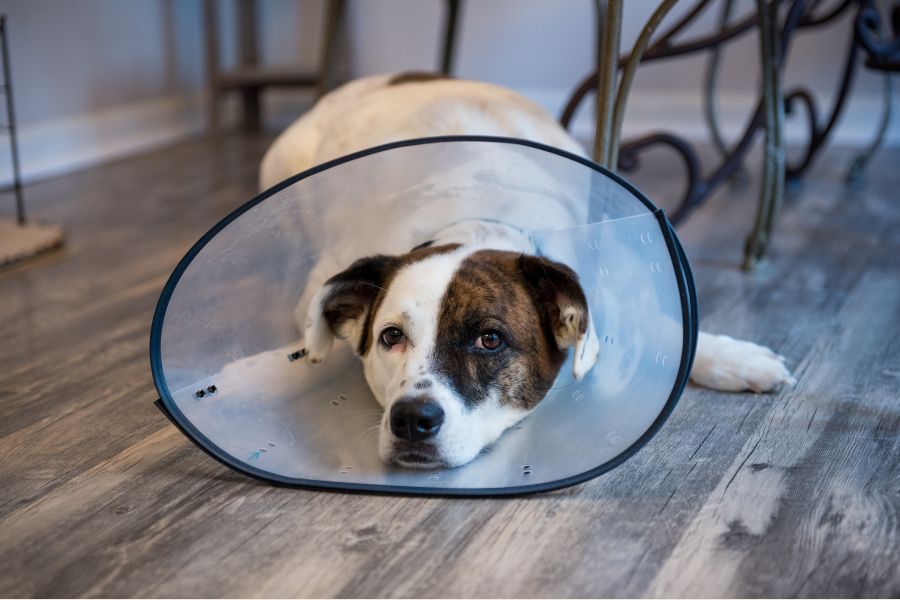
Your dog was chasing a ball in the yard last weekend. Now she’s holding up a back leg, or hopping on three legs for a few steps before easing back into a limp. Maybe it got better with a couple of quiet days, then came right back the moment she got excited about the mailman.
That pattern – a hind-leg limp that improves with rest and returns with activity – is one of the most common reasons dogs come to see us at Tranquility Veterinary Clinic. And more often than not, the culprit is the cranial cruciate ligament.
What Is A Cranial Cruciate Ligament Tear?
The cranial cruciate ligament (CCL) is the band of tissue inside the knee that keeps the shin bone from sliding forward out from under the thigh bone. It’s the dog’s version of the ACL in a human knee.
Here’s the part that surprises most pet owners: in dogs, a CCL injury usually isn’t a single dramatic accident. It’s a slow, degenerative process. The ligament frays and weakens over months, and the leap off the couch that finally snaps it is just the last straw. That’s also why a dog who tears one CCL has a meaningful chance of tearing the other one down the road – the same underlying process is often at work in both knees.
Once the ligament goes, the knee becomes unstable. Every step irritates the joint, and arthritis begins to set in. Left untreated, most dogs stay painful, and the joint continues to deteriorate.
Signs To Watch For
Give us a call if you notice your dog:
- Limping on a hind leg after exercise, especially if it comes and goes
- Sitting with one back leg kicked out to the side instead of tucked underneath
- Hesitating to jump into the car, climb stairs, or get up on the furniture
- Slow to rise after a nap, or stiff first thing in the morning
- Losing muscle in one thigh compared to the other
- Making a clicking sound in the knee while walking
A limp that lasts more than a few days is always worth an exam. The earlier we diagnose a cruciate problem, the less arthritis your dog is likely to carry later.
How Mmp Surgery Works
MMP stands for the Modified Maquet Procedure, and it takes a different approach than you might expect. Rather than trying to repair or replace the torn ligament – which doesn’t heal reliably on its own – MMP changes the mechanics of the knee so the ligament is no longer needed for stability.
Dr. Christensen makes a precise cut in the tibial tuberosity, the ridge of bone at the front of the shin where the kneecap tendon attaches, and advances it forward. A wedge-shaped titanium implant holds the bone in its new position. That small shift realigns the pull of the patellar tendon so the joint stays stable under your dog’s own body weight – no ligament required.
The implant itself is what makes MMP distinctive. It’s a porous titanium foam, and bone grows directly into that open structure, creating permanent fixation without the need for a separate bone graft. Published research shows the wedge begins integrating with the surrounding bone within about 30 days, with healing generally complete by around 90 days.
Getting the implant size right is critical, because the amount of advancement is matched to each dog’s knee. To make sure every implant is sized correctly, Dr. Christensen works with board-certified surgeons in London, adding an extra layer of expertise to the planning behind your dog’s surgery.
Why We May Recommend It
Compared with some other cruciate repairs, MMP is a less invasive procedure. It doesn’t require rotating and re-plating the top of the tibia the way a TPLO does; it typically takes less time under anesthesia, and it uses fewer implants. Just as important for your dog’s comfort, MMP patients can be weight-bearing within hours of surgery, and sometimes immediately after.
At Tranquility Veterinary Clinic, we most often recommend MMP for medium to large dogs who are active and otherwise in good health. That said, every knee is different. Dr. Christensen evaluates each patient individually – a hands-on orthopedic exam plus radiographs – before recommending a surgical plan. Sometimes MMP is the best answer; sometimes another approach fits your dog better, and we’ll tell you so.
What Recovery Looks Like
Because MMP dogs can be weight-bearing so quickly, many owners are surprised by how soon their dog is up and walking. Most dogs go home the same day or the following morning. But feeling good is not the same as being healed, so the single most important factor in a good outcome is strict activity restriction for roughly six to eight weeks: leash walks only, no stairs, no jumping, no off-leash time, no roughhousing with the other dog in the house. We know that’s hard. It’s also what protects the healing bone while the implant integrates.
We’ll schedule recheck radiographs to confirm the bone is healing as expected, then guide you through a gradual return to normal activity. Along the way, we’ll talk about keeping your dog at a healthy weight, and we may send you home with simple exercises to help rebuild thigh muscle.
The reported success of MMP is 80% to 90% healthy limb function by six months after surgery. Complications are relatively uncommon, but as with any orthopedic surgery, they are possible – we’ll walk you through the specific risks for your dog before you make a decision.
About Dr. Ryan E. Christensen
Dr. Ryan. E. Christensen is the owner and medical director of Tranquility Veterinary Clinic, a role he has held since 2017. He earned his Bachelor of Science in Biology, with a minor in Chemistry, from Monmouth University, graduating magna cum laude in 1998, and his Doctor of Veterinary Medicine from Iowa State University’s College of Veterinary Medicine, graduating with honors in 2002 before joining Tranquility Veterinary Clinic.
Throughout his training, he worked as a veterinary technician in hospitals across New Jersey and Iowa, and his experience at Iowa State focused on small animal medicine and surgery, including a surgical externship at the Nebraska Humane Society in Omaha, Nebraska. His professional interests include small animal surgery, cranial cruciate ligament disease, and ultrasonography. He is a member of the AVMA and the NJVMA.
Worried About Your Dog’s Limp?
You don’t have to guess. If your dog is favoring a back leg, our team can examine the knee, take radiographs, and give you a clear picture of what’s going on – and whether MMP surgery is the right option.
Call us at 908-852-7800 or book online to schedule an evaluation.
Related Articles